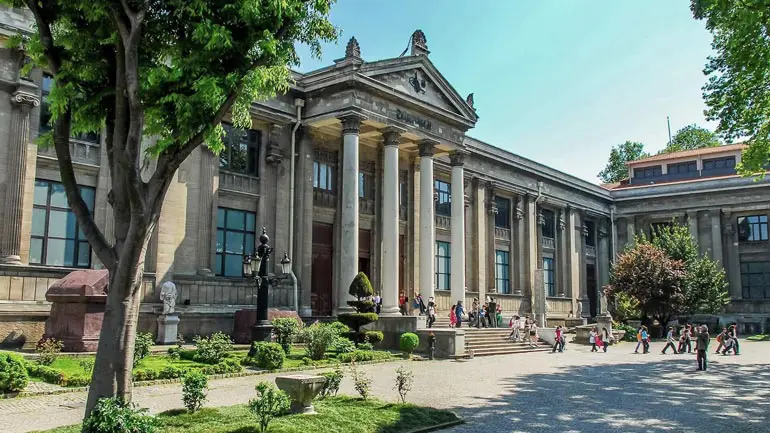
Hagia Sophia in Istanbul is not merely a historical monument; it is a living narrative of nearly 15 centuries of world history’s ups and downs. This architectural masterpiece, located in the heart of Istanbul’s historic district, was once the largest cathedral in the world, then became one of the most important mosques of the Ottoman Empire, later served as a museum for a time, and today once again hosts worshippers and millions of tourists from around the globe. Its breathtaking architecture, massive dome, priceless Byzantine mosaics, and magnificent Islamic calligraphic panels make Hagia Sophia one of the most unique buildings in the world. In this article, we will explore the history, architecture, notable sections, and important tips for visiting the Hagia Sophia Mosque in Istanbul.

History of Hagia Sophia Mosque
Hagia Sophia was built in 537 AD by order of Emperor Justinian I of the Byzantine Empire and was considered the largest cathedral in the world at the time. The construction of this structure took only about six years, which is an astonishing achievement for a project of such grandeur.
The name “Hagia Sophia” comes from the Greek language and means “Holy Wisdom.” Contrary to popular belief, it is not the name of a person.
For nearly a thousand years, this building served as the primary center of the Eastern Orthodox Church, and many Byzantine emperors held their coronation ceremonies within its walls.

The Conversion of the Cathedral into a Mosque
In 1453 AD, with the conquest of Constantinople by Sultan Mehmed II (Mehmed the Conqueror), Hagia Sophia was converted into a mosque.
During this period, significant changes were made to the building, including:
Installation of a mihrab (prayer niche) facing Mecca
Construction of a minbar (pulpit)
Addition of four minarets
Installation of large chandeliers
Covering many Christian paintings and mosaics with plaster
However, many of the Christian artworks were not destroyed but merely concealed beneath a layer of plaster—a fact that later doubled the historical value of the structure.

Hagia Sophia during the Republic of Turkey
In 1935, by order of Mustafa Kemal Atatürk, Hagia Sophia was converted from a mosque into a museum.
During extensive restoration efforts, the plaster layers were removed, and many of the exquisite Byzantine mosaics were once again revealed. For this reason, visitors were able to see both Islamic and Christian art side by side.
Finally, in 2020, the Turkish government reconverted Hagia Sophia into a mosque. Today, in addition to hosting daily prayers, the building welcomes millions of tourists from all over the world.

The Remarkable Architecture of Hagia Sophia
Hagia Sophia is considered one of the world’s most outstanding architectural masterpieces, and even after nearly 1,500 years, it continues to amaze engineers and architects.
Its most significant architectural features include:
A massive dome with a height of approximately 56 meters
A dome diameter of nearly 31 meters
The use of marble columns imported from various cities of the Roman Empire
Natural lighting through dozens of windows around the base of the dome
A fusion of Roman, Byzantine, and Islamic architectural styles
At the time of its construction, Hagia Sophia’s dome was the largest in the world and served as a model for the construction of many Ottoman mosques, including the Blue Mosque of Istanbul.

Notable Sections of Hagia Sophia
A visit to Hagia Sophia is not limited to simply seeing a mosque. Throughout this historic building, numerous valuable artifacts can be found.
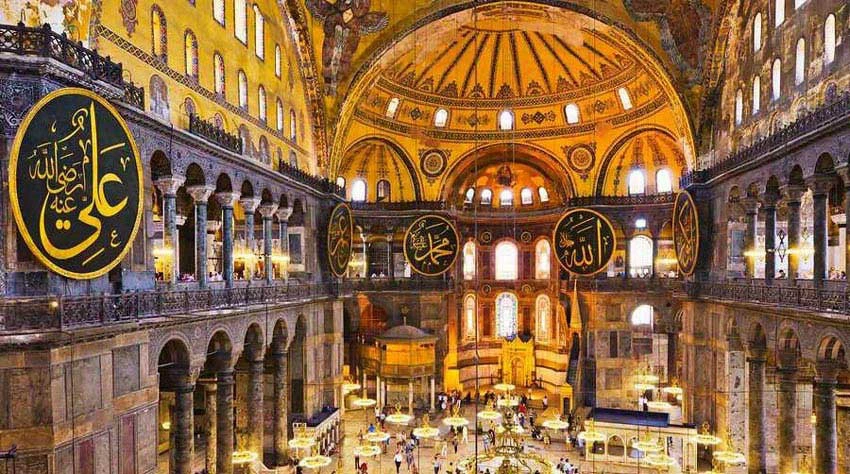
The Great Dome
The most famous feature of Hagia Sophia is its massive dome, designed in such a way that it appears to float in the air.
Byzantine Mosaics
The images of the Virgin Mary, Jesus Christ, and angels are among the most significant artworks inside the building, dating back over a thousand years.
Magnificent Islamic Calligraphic Panels
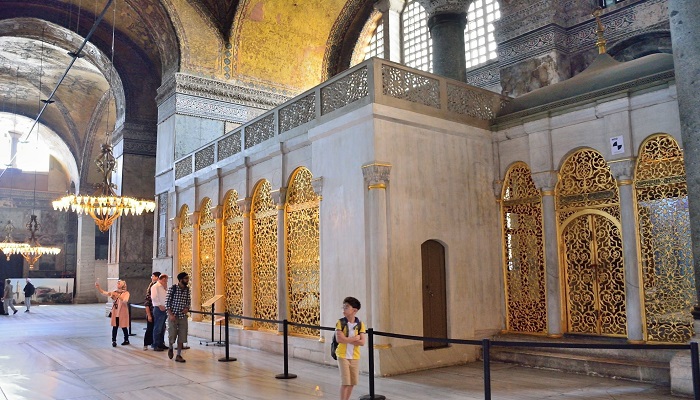
Eight large circular medallions bearing the names of Allah, the Prophet Muhammad (PBUH), the Rightly Guided Caliphs, Imam Hasan (AS), and Imam Hussein (AS) are among the most prominent symbols from the Ottoman era.
Mihrab and Minbar
These sections were added to the building after the conquest of Istanbul and continue to be used for daily prayers.
The Wishing Column
One of Hagia Sophia’s most famous columns is one where tourists place their fingers into a hole and believe that by rotating their hand, their wishes will come true.

Why is Hagia Sophia of Global Importance?
Hagia Sophia is not just a mosque or a church; it is a symbol of the coexistence of different cultures and civilizations. Few buildings in the world have preserved remnants of three major historical periods—Byzantine, Ottoman, and the Turkish Republic—all within the same structure.
For this reason, Hagia Sophia, along with the historic areas of Istanbul, is inscribed on the UNESCO World Heritage List, attracting millions of tourists from around the globe each year.
Best Time to Visit
The best times to visit Hagia Sophia are during the spring (April to June) and autumn (October to November). During these months, Istanbul’s weather is more pleasant, and tourist crowds are smaller compared to summer.
For photography, the early morning hours or late afternoon provide the best lighting.
Address and How to Get There
Address: Sultanahmet Square, Fatih District, Istanbul, Turkey
By Tram
The easiest way to reach Hagia Sophia is by taking the T1 tram line and getting off at the Sultanahmet station. From this station, it is only a few minutes’ walk to the mosque’s entrance.
Additionally, many of Istanbul’s major attractions—such as the Sultan Ahmed Mosque (Blue Mosque), Topkapi Palace, the Basilica Cistern, and Gülhane Park—are located within a short distance of Hagia Sophia, allowing you to visit them all in a single day.
Final Word
Hagia Sophia is not just a historical monument; it is a living narrative of the history of human civilization. Its breathtaking architecture, majestic dome, thousand-year-old mosaics, Islamic calligraphy, and a legacy that stretches from the Byzantine Empire through the Ottoman era to the modern Turkish Republic make it one of the most valuable historical sites in the world. If you travel to Istanbul, visiting Hagia Sophia is an experience not to be missed—for within every corner of this magnificent edifice, a part of world history is being told.