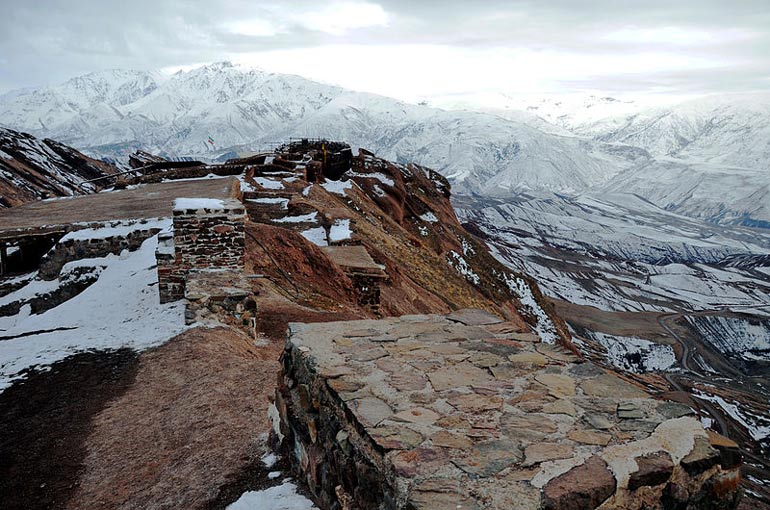
Alamut Castle is one of Iran’s most famous historical fortresses, perched atop a towering rock formation in the Alborz Mountains, in the Alamut region of Qazvin Province. Closely associated with the life and activities of Hasan Sabbah and the history of the Nizari Ismailis, the castle was once one of Iran’s most important political, military, and intellectual centers. Its unique natural setting, ingenious defensive architecture, and rich historical narratives have made Alamut one of the country’s most remarkable historical sites.
For centuries, this fortress resisted enemy attacks. It was not merely a military stronghold, but also the center of administration for a mountain-based state, a place of religious and scholarly activity, and a repository of valuable books and scientific works. Today, the remains of its walls, towers, and structures, set against expansive mountain scenery, offer visitors a glimpse into the grandeur of its past.
The historical significance of Alamut Castle is so remarkable that, in 2026, the “Alamut Castle and Associated Fortifications” complex was inscribed on the UNESCO World Heritage List, further highlighting its importance to the world’s cultural heritage.
Where Is Alamut Castle Located?
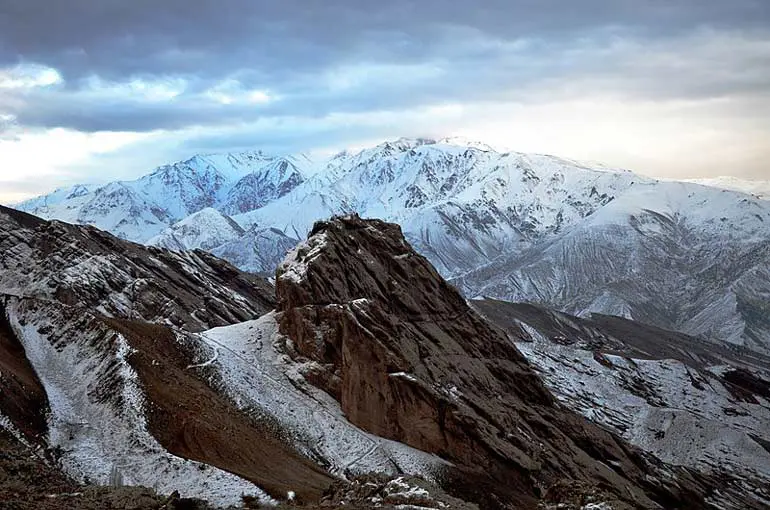
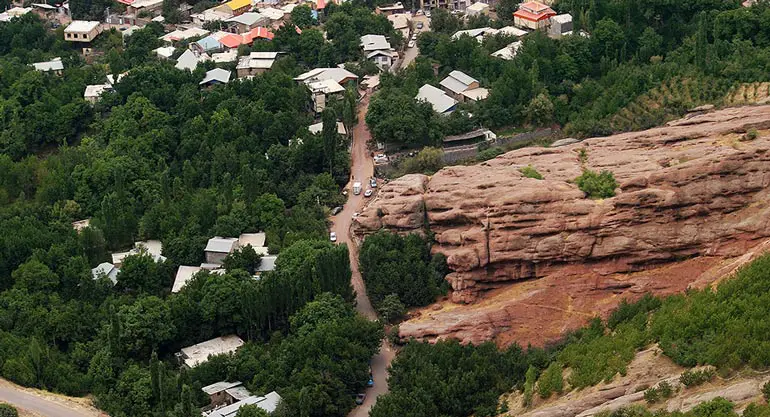
Alamut Castle is located in Qazvin Province, in the Eastern Rudbar of Alamut District, near the village of Gazorkhan. This historic fortress was built atop a high, rugged rock, offering sweeping views of the Alamut Valley and the surrounding mountain villages.
The castle stands at an elevation of approximately 2,100 meters above sea level, while the rock on which it was built rises about 200 meters above the surrounding terrain. This strategic position made the fortress difficult to access in the past and prevented attackers from approaching it easily.
The name Alamut is also associated with an old legend involving an eagle. According to a well-known story, an eagle showed a local ruler the ideal location for building a fortress. In this tale, the name Alamut is derived from words in the Daylamite language meaning “Eagle’s Nest” or “Eagle’s Training Ground.” However, this explanation is largely legendary, and different theories have been proposed regarding the true origin of the name Alamut.
History of Alamut Castle: From Mountain Fortress to the Center of Ismaili Rule
The history of Alamut Castle dates back centuries before Hasan Sabbah arrived in the region. Historical and archaeological studies suggest that the fortress was built in the 9th century AD, during the rule of the Justanid dynasty, and gradually expanded over time. Hasan Sabbah, therefore, was not the original founder of the castle; rather, by capturing it, he transformed Alamut into one of the most important centers of power in Iranian history.
Hasan Sabbah’s Arrival at Alamut Castle
One of the most significant events in the history of this fortress was its capture by Hasan Sabbah in 1090 AD, corresponding to approximately 483 AH.
Hasan Sabbah was a prominent figure in the history of the Ismailis who, after years of religious and political activity, chose Alamut as his principal stronghold. The castle’s natural position, considerable elevation, difficult access routes, and ability to oversee the surrounding valleys made it an ideal place for settlement and defense.
With Hasan Sabbah’s establishment at Alamut, the fortress became the center of the Nizari Ismaili state. This state held influence over various regions of Iran and neighboring territories and continued to exist for nearly 166 years, until the Mongol invasion.

Alamut: A Scientific and Cultural Center of the Ismailis
Contrary to popular belief, Alamut Castle was not merely a military base. During the rule of the Ismailis, it developed into an important center of scientific, religious, and cultural activity.
During this period, the castle housed a valuable library containing religious, philosophical, and scientific books, along with works representing the knowledge of the time. Research and educational activities were also carried out there, and scholars and intellectuals were present at the fortress.
The existence of such a library demonstrates that Alamut held a special place in Iran’s intellectual and cultural history, in addition to its political and military importance.
The Fall of Alamut Castle and the Mongol Invasion
The era of Alamut Castle’s power came to an end in 1256 AD, corresponding to 654 AH, when Mongol forces under Hulagu Khan attacked the fortress.
As the Mongols advanced into territories under Ismaili control, Alamut Castle was also besieged. Eventually, Rukn al-Din Khurshah, the last Nizari ruler of this period, surrendered, and the castle fell into Mongol hands.
Following its capture, parts of the fortress were destroyed, and its valuable library suffered severe damage, resulting in the loss of many of its works. This event is considered one of the major cultural losses in Iranian history.
Afterward, Alamut gradually lost its former importance and, in later periods, was used for various purposes, including as a prison and place of exile for a time.
Architecture of Alamut Castle: A Fortress Perched on a Rocky Peak
One of the most remarkable features of Alamut Castle is its architecture, which is seamlessly integrated with the natural landscape of the mountains. Rather than constructing a separate structure on flat ground, the builders made use of the rock formations and natural slopes to create a defensive complex.
The castle was built on a massive rock and is surrounded on all sides by steep slopes and cliffs. These natural barriers made it difficult for enemies to reach the fortress and greatly enhanced its defensive capabilities.
The main architectural features of the castle include:
1. The Eastern and Western Sections of the Castle
The castle is divided into two main sections, which are also locally and architecturally referred to as the Upper Castle and Lower Castle. These sections were shaped according to the natural contours of the rock and the defensive requirements of the complex.
2. Towers and Defensive Walls
Remains of towers and defensive walls can be seen throughout the castle. These structures were built to guard access routes, control movement, and defend the fortress against potential attacks.
3. The Entrance and Access Route
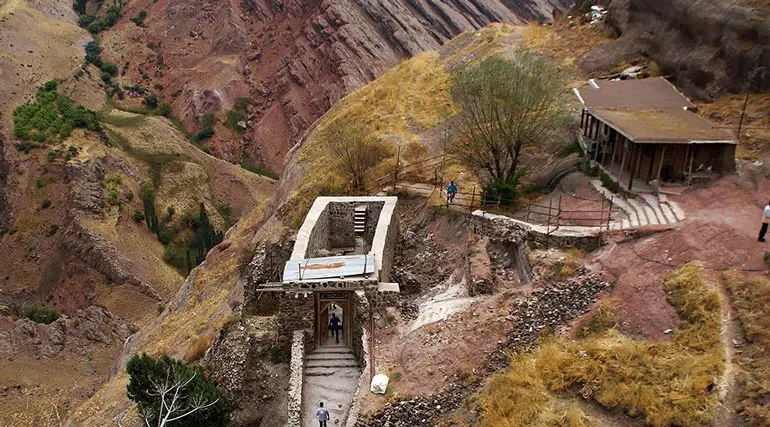
One of the castle’s architectural features is its limited number of entrances. The main entrance was located on the northeastern side, and the passageway was designed to run through the rocky terrain. This arrangement allowed the defenders to control access to the fortress.
4. Cisterns and Water Storage Systems
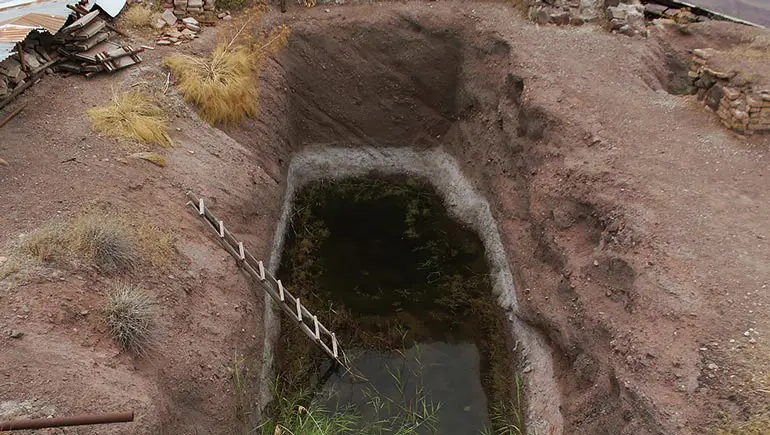
Water supply was extremely important for a fortress built on a high rocky peak. For this reason, structures were created within the Alamut complex to store and manage water, allowing its inhabitants to maintain access to water even during times of siege.
5. Stone Structures and Interior Spaces
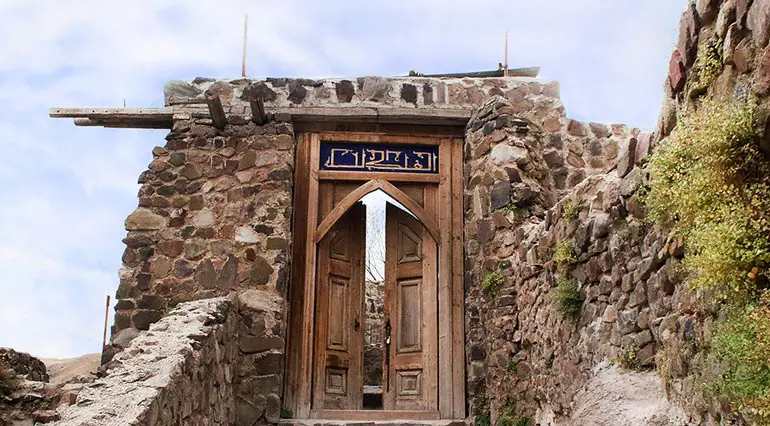
Stone and materials such as gypsum mortar were used in the construction of different sections of the castle. The surviving remains still demonstrate the builders’ skill in using local materials and adapting their architecture to the challenging environmental conditions.
Legends and Famous Stories About Alamut Castle
Alamut Castle has been associated with numerous stories and legends throughout history. Some of these accounts are rooted in historical events, while others have become intertwined with myths and storytelling over time.
One of the most famous subjects associated with Alamut is the story of the Ismaili Fidāʾīs and the term “Assassins.” Popular accounts tell stories of paradise gardens, the use of narcotics, and the training of individuals for special missions. However, many of these narratives originated in later historical sources and biased or embellished accounts, and they cannot be considered established historical facts.
What is historically significant is the existence of an organized political and military structure among the Nizari Ismailis, as well as their use of mountain fortresses to preserve their independence and confront the major powers of their time.
The castle’s extraordinary location and the towering cliffs surrounding it also contributed to the development of mysterious stories and legends about Alamut.
Alamut Castle and Its UNESCO World Heritage Inscription
One of the important events in the modern history of this complex was the inscription of “Alamut Castle and Associated Fortifications” on the UNESCO World Heritage List in 2026.
The nomination is not limited to the main Alamut Castle; it includes a group of seven historical fortresses and defensive structures scattered throughout the Alamut region of Qazvin Province.
These seven sites are:
– Alamut Castle
– Lambesar Castle
– Nowizar Shah Fortifications
– Shams Kalayeh Fortifications
– Qastin Lar Fortifications
– Shirkuh Fortifications
– Ilan Fortifications
The complex was inscribed on the UNESCO World Heritage List under Cultural Criterion III because it represents a cohesive defensive system and reflects the historical, cultural, and intellectual significance of the Nizari Ismailis.
This inscription is highly significant, as it demonstrates that Alamut was not merely an isolated historical castle, but part of an extensive network of defensive, cultural, and administrative centers that played an important role in the history of the Alborz region and Iran.
Best Time to Visit Alamut Castle
The Alamut region has a mountainous climate due to its location in the Alborz range, and weather conditions vary considerably throughout the year.
Spring: Spring is one of the best seasons to visit Alamut. During this time, the landscape becomes lush and green, orchards blossom, and the mountain climate creates pleasant conditions for exploring nature. However, early spring can still be cold, and some days may be rainy.
Summer: Summer is also a good time to visit Alamut Castle. Compared with many of Iran’s hotter cities, the region enjoys cooler weather, making it possible to appreciate the mountain scenery, villages, and surrounding orchards.
Autumn: In autumn, the trees and orchards around the castle turn shades of yellow, orange, and red. This season is particularly attractive for photography and enjoying the autumn scenery, although visitors should be prepared for colder temperatures and shorter days.
Winter: Snowfall and severe cold in winter can make access roads to the castle difficult. Therefore, traveling during this season requires checking road conditions and the weather forecast before setting out.
How to Get to Alamut Castle
To reach Alamut Castle, travel from Qazvin Province toward the Alamut region of Rudbar. The usual route follows the road from Qazvin to Moallem Kalayeh and then continues to the village of Gazorkhan.
The distance from Qazvin to Alamut Castle is approximately 100 to 110 kilometers. Depending on road conditions, traffic, and weather, the journey may take around two to three hours.
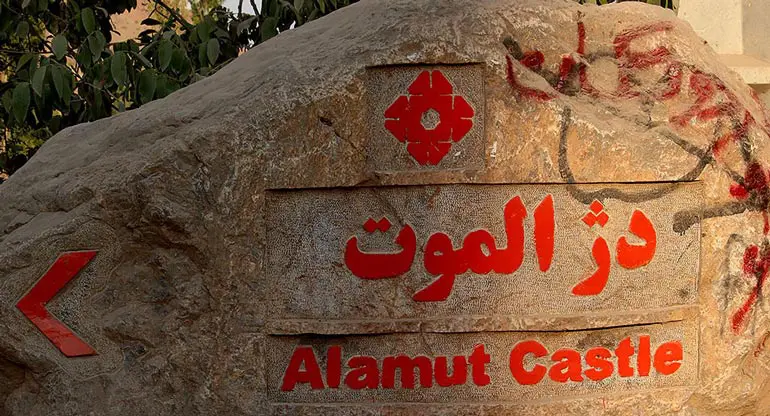
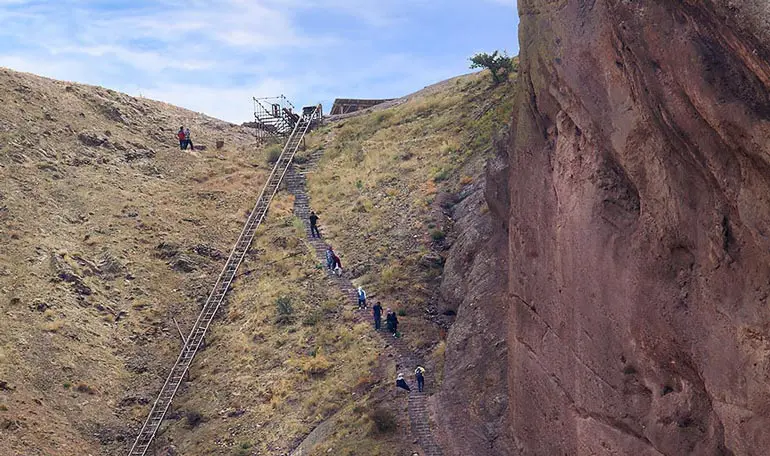
After reaching Gazorkhan Village, continue toward the castle entrance. From there, the remaining journey is on foot, along stairs and a mountainous path.
Because of the castle’s elevation and the many steps along the route, it is advisable to wear comfortable walking shoes and allow sufficient time for the ascent and exploring the different sections of the complex.
Attractions Near Alamut Castle
A visit to Alamut Castle also provides an excellent opportunity to explore other historical and natural attractions in the region. With its old villages, lakes, springs, lush orchards, and numerous historical sites, the Alamut Valley is one of the most appealing tourist destinations in Qazvin Province.
Lambesar Castle
One of the most important historical fortresses of the Ismailis in the Alamut region. Situated on elevated terrain, it is notable for its defensive design and architectural remains.
Ovan Lake
A beautiful lake nestled among the mountains of Alamut. With its clear water and natural scenery, it is considered one of the region’s most famous attractions.
Gazorkhan Village
A mountain village near Alamut Castle, known for its fruit orchards, traditional rural atmosphere, and beautiful views. It is an appealing part of any visit to the region.
Alamut Valley
A mountainous region with diverse landscapes, picturesque villages, and scenic roads, making it ideal for nature exploration and experiencing rural life.
Accommodation Near Alamut Castle
Visitors to Alamut can stay in eco-lodges, local guesthouses, and other accommodation facilities in the surrounding villages. Gazorkhan Village, due to its proximity to the castle, is one of the convenient options for accommodation and experiencing rural life in Alamut.
Accommodation is also available in some nearby villages and in the town of Moallem Kalayeh. If you plan to stay in the region for several days and explore different attractions throughout Alamut, it is best to choose your accommodation based on your sightseeing itinerary.
Before traveling, particularly during less busy seasons, make sure your chosen accommodation is open and available for booking.
Important Tips for Visiting Alamut Castle
To enjoy a safer and more comfortable visit to this historical site, keep the following points in mind:
– Wear comfortable walking shoes and clothing suitable for the mountain weather.
– The route to the castle includes stairs and steep sections, so a reasonable level of physical fitness is required.
– Bring drinking water and essential travel supplies.
– Check road conditions and the weather forecast before departure.
– Avoid climbing on the walls or damaging the surviving architectural remains.
– Allow enough time to take photographs and enjoy the surrounding scenery.
Why Is Alamut Castle Worth Visiting?
Alamut Castle is one of those attractions where the experience goes far beyond simply viewing the remains of a historical monument. Its position atop a massive rock, the breathtaking scenery of the Alborz Mountains, the historical stories of Hasan Sabbah, and the fascinating history of the Ismailis combine to offer visitors a unique journey into Iran’s past.
The castle is a reminder of a time when people, through their deep understanding of nature and strategic use of geographical features, built extraordinary structures for living and defending their territory. The UNESCO World Heritage inscription of the Alamut complex also provides a valuable opportunity to introduce this heritage to a wider audience and preserve it for future generations.
If you are interested in Iranian history, military architecture, and mountain destinations with a rich historical background, visiting Alamut Castle can be one of the most memorable experiences of your trip to Qazvin Province.