The Ferdowsi Mausoleum is one of the most important historical and cultural attractions in Razavi Khorasan Province. It is located in the historic city of Tus, northwest of Mashhad. The complex is a memorial to Hakim Abol-Qasem Ferdowsi, the great Iranian poet and author of the Shahnameh, a valuable literary masterpiece that has played a significant role in preserving the Persian language, Iranian culture, and the myths and history of Iran. With its architecture inspired by ancient Iranian monuments, landscaped gardens, and cultural atmosphere, the Ferdowsi Mausoleum is one of Mashhad’s notable destinations for visitors interested in history, literature, and architecture.
Visiting this complex offers an opportunity to learn about Ferdowsi’s life, the stories of the Shahnameh, and the history of the ancient city of Tus. Its location near other historical landmarks in the area, including the Haruniyeh Dome, also makes it possible to plan a cultural excursion around Mashhad.

Where Is the Ferdowsi Mausoleum?
The Ferdowsi Mausoleum is located in the historic city of Tus, approximately 20 to 25 kilometers northwest of Mashhad, in Razavi Khorasan Province. The complex is situated along Shahnameh Boulevard, at the end of Baharestan Boulevard. It can be reached via the Mashhad–Quchan road and routes leading to Tus.
Tus is one of the ancient historical cities of Khorasan and has been home to prominent literary and scholarly figures throughout history. The Ferdowsi Mausoleum is the most important cultural attraction in this area, and many tourists visit it alongside their pilgrimage to Mashhad.

Who Was Ferdowsi, and Why Is His Mausoleum Important?
Hakim Abol-Qasem Ferdowsi, the renowned Iranian poet, lived around the fourth and fifth centuries AH. He was born in the Tus region of Khorasan and devoted much of his life to composing the Shahnameh, an epic poem that brings together Iran’s mythological, heroic, and historical narratives in Persian verse.
The Shahnameh is more than a collection of stories about kings and heroes. It reflects Iranian beliefs, values, mythology, and perspectives on concepts such as wisdom, justice, courage, loyalty, and destiny. Characters such as Rostam, Sohrab, Siavash, Zal, and Esfandiyar hold prominent places in this work, and their stories remain an enduring part of Iranian culture centuries later.
Through the Shahnameh, Ferdowsi made a significant contribution to the continuity and richness of the Persian language. For this reason, his mausoleum is more than the burial place of a poet; it is a monument dedicated to Persian literature and Iran’s cultural identity.

History of the Ferdowsi Mausoleum
The history of the Ferdowsi Mausoleum stretches back many centuries. According to historical accounts, Ferdowsi was buried in his own garden in Tus. In the centuries that followed, his burial place attracted the attention of admirers of Persian poetry and literature, and historical records mention the existence of a structure over his grave at different times.
Over time, political changes and destruction in the Tus region damaged the mausoleum, and eventually little remained of the earlier structures. During the Qajar period, efforts were made to identify the poet’s burial site and construct a suitable monument. However, a mausoleum worthy of this great poet was not fully realized until the early 14th century in the Iranian calendar.
In the modern era, growing interest in Iran’s cultural and literary heritage led the National Association of Monuments of Iran to pursue the construction of a memorial befitting Ferdowsi’s status. Construction of the new building began in 1307 SH (1928–1929), and the mausoleum was inaugurated in 1313 SH (1934), during the celebrations marking the millennium of Ferdowsi.
The original structure developed technical problems and settlement issues that required major reconstruction. In the 1340s SH (1960s), Houshang Seyhoun took responsibility for redesigning and renovating the mausoleum. The building’s present appearance emerged from modifications to the earlier design. The reconstructed complex was officially reopened in 1347 SH (1968–1969).
This history demonstrates that the present mausoleum is the result of several generations’ efforts to preserve Ferdowsi’s memory and legacy.

Architecture of the Ferdowsi Mausoleum
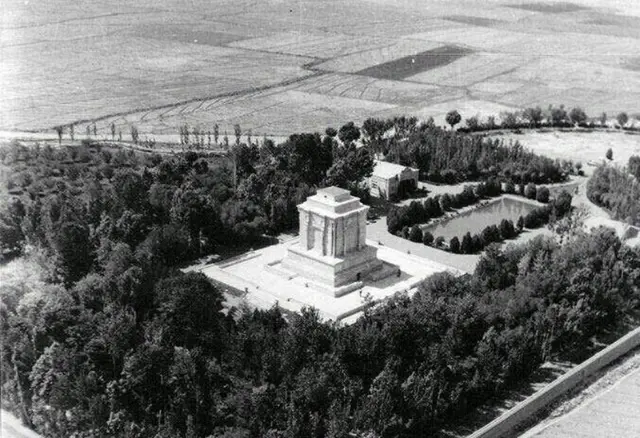
One of the most remarkable features of the Ferdowsi Mausoleum is its architecture, which draws inspiration from ancient Iranian monuments, particularly Achaemenid architecture and the Tomb of Cyrus the Great at Pasargadae. Its regular geometric forms, light-colored stone, columns, and tiered platforms give the monument a majestic appearance.
The main mausoleum stands on an elevated platform, and its overall structure is based on geometric proportions and orderly lines. Stone plays a central role in the design, while the combination of columns and carved decorations creates a visual connection between the contemporary memorial and the art of ancient Iran.
The design aims to make the mausoleum not only a burial monument but also a symbol of Iran’s cultural and historical grandeur. Its architecture therefore complements the literary spirit of the Shahnameh and Ferdowsi’s national significance.

Stone Columns and Decorations
The stone columns and architectural details are among the mausoleum’s most distinctive features. Various sections of the building display motifs and decorations inspired by Achaemenid art and architecture. Together with the building’s cubic form and tiered platform, these elements give the structure its distinctive appearance.

Shahnameh Inscriptions and Reliefs
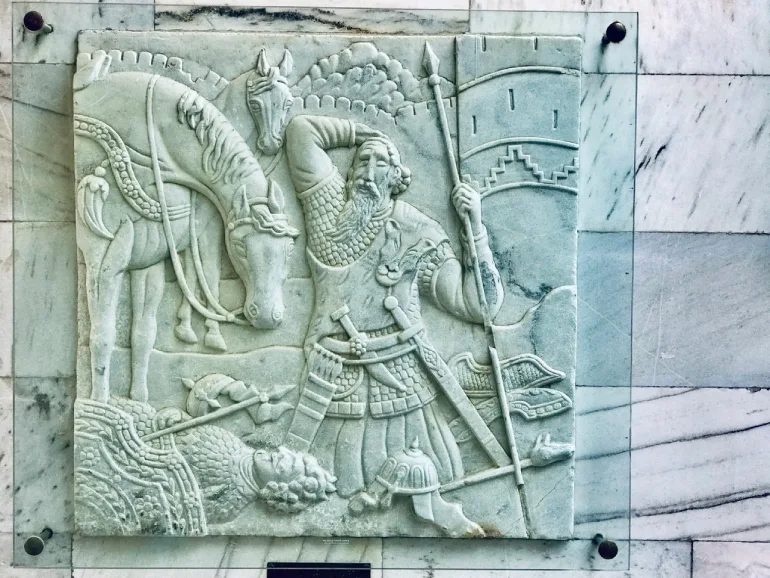
Parts of the mausoleum are decorated with inscriptions, verses, and reliefs associated with the Shahnameh and its stories. These decorations demonstrate the connection between the building’s architecture and the literary content of Ferdowsi’s masterpiece.
The depiction of Shahnameh stories throughout the mausoleum offers visitors a chance to become more familiar with the characters and narratives of this celebrated work. As a result, the monument has educational and cultural value in addition to its architectural significance.

Different Sections of the Ferdowsi Mausoleum Complex
1. The Main Mausoleum
The most important part of the complex is the stone mausoleum, with Ferdowsi’s tombstone located in its central section. This building is the focal point of the grounds, and most visitors come here to pay their respects to the poet and admire the architecture.
The interior and exterior feature stonework, inscriptions, and monumental architectural elements. Observing the building’s details from different angles is particularly appealing to visitors interested in architecture and photography.

2. Gardens and Green Spaces
The Ferdowsi Mausoleum stands within a garden-like setting. Trees, landscaped areas, and walking paths provide a pleasant environment for visitors to stroll and take short breaks.
The combination of the garden and the stone monument makes the complex more than just a memorial building. In spring, the greenery gives the grounds a special charm, while the changing colors of the leaves in autumn can create beautiful scenery.

3. Ferdowsi Museum and Cultural Sections
The mausoleum complex has included museum and cultural sections dedicated to Ferdowsi, the Shahnameh, and Iran’s literary heritage. Historical objects, items related to Iranian culture and art, and representations of Shahnameh stories are among the subjects associated with these exhibitions.
The operating status of museum sections, exhibitions, and access to indoor areas may change over time. It is therefore advisable to check the latest information before visiting.

4. The Mausoleum of Mehdi Akhavan Sales
Mehdi Akhavan Sales, a prominent contemporary Iranian poet, is also buried within the Ferdowsi Mausoleum complex. Akhavan Sales was an important figure in modern Persian poetry, particularly known for his socially conscious and epic poetry.
The presence of his tomb within the complex creates a connection between classical Persian literature and contemporary Iranian poetry. Visitors interested in Persian verse can pay their respects to this modern poet alongside Ferdowsi.

5. The Mausoleum of Mohammad Reza Shajarian
Mohammad Reza Shajarian, one of Iran’s most celebrated masters of traditional Persian singing, passed away on October 8, 2020, and was buried in the Ferdowsi Mausoleum complex in Tus on October 10, 2020. His burial place creates a symbolic connection between traditional Iranian music and the literary heritage of Hakim Abol-Qasem Ferdowsi.
Throughout his artistic career, Shajarian played an important role in preserving and promoting traditional Iranian music. Through his memorable vocal performances and songs, he earned a special place among admirers of Persian music. His collaborations with prominent musicians, interpretations of works based on the poetry of great Persian poets, and attention to the subtleties of traditional Iranian singing are among the defining features of his artistic legacy.
Shajarian’s tomb is located within the cultural complex of the Ferdowsi Mausoleum. Music lovers and visitors interested in Iranian culture can visit it alongside the tombs of Ferdowsi and Mehdi Akhavan Sales. The presence of this renowned musician in Tus makes the complex a place that commemorates important aspects of Iran’s literary and artistic heritage.
For admirers of traditional Persian singing, visiting Shajarian’s tomb is an opportunity to pay tribute to an artist who devoted a significant part of his life to the music and culture of Iran.
Why Is Visiting the Ferdowsi Mausoleum Worthwhile?
The Ferdowsi Mausoleum appeals to a wide range of visitors. Literature enthusiasts can learn more about one of the most influential figures in Persian poetry and his enduring masterpiece. Those interested in history and architecture can admire a monument inspired by ancient Iranian architectural traditions.
The garden setting and the complex’s location in the historic city of Tus also make it a suitable destination for families. A visit can introduce children and teenagers to the stories of the Shahnameh and an important part of Iran’s cultural heritage.
For travelers who know Mashhad mainly for its religious attractions and shopping centers, a trip to Tus offers a different perspective on the region’s historical and cultural attractions.

Best Time to Visit the Ferdowsi Mausoleum
Spring and autumn are among the best seasons to visit the Ferdowsi Mausoleum. In spring, mild weather and green surroundings create pleasant conditions for walking. Autumn is also a good time for exploring the grounds, thanks to cooler temperatures and the changing colors of the trees.
Summers in Mashhad and the surrounding areas can be hot, so it is best to visit during the cooler hours of the day. In winter, cold weather and possible rainfall may affect outdoor activities.
If you plan to visit during Nowruz, weekends, or events commemorating Ferdowsi, allow extra time to explore the complex.

Address of the Ferdowsi Mausoleum
Ferdowsi Mausoleum Cultural Complex, Baharestan Boulevard, at the end of Shahnameh Boulevard, Tus, Mashhad, Razavi Khorasan Province, Iran.
The complex is located northwest of Mashhad, outside the city center. To find the precise route, search for “Ferdowsi Mausoleum” in navigation applications such as Neshan or Balad.

How to Get to the Ferdowsi Mausoleum
By Private Car
To reach the mausoleum, travel from Mashhad toward the Mashhad–Quchan road, then follow the routes leading to the historic city of Tus and Shahnameh Boulevard. Local road signs and navigation applications can guide you to the entrance.
The exact distance and travel time depend on your starting point, traffic conditions, and the route you choose. Check the route before setting off and allow sufficient time for the return journey.
By Taxi or Ride-Hailing Service
Taking a taxi or using a ride-hailing service is a convenient way to visit the Ferdowsi Mausoleum. This option is particularly practical for families and visitors who want to explore other historical attractions in Tus on the same day.
By Public Transportation
If you plan to use public transportation, check bus routes serving Ferdowsi Terminal and connections to the Tus area. Routes and bus numbers may change, so consult Mashhad’s latest public transportation information before traveling.

Recommended Time for a Visit
Allow approximately one to two hours to see the main monument, examine its architectural details, walk through the grounds, and visit the sections that are open to the public. If you are particularly interested in Persian literature, the history of Tus, or photography, you may wish to spend more time there.
If you plan to visit the Ferdowsi Mausoleum along with other historical attractions in Tus, setting aside half a day for the area is a good idea.

Places to Visit Near the Ferdowsi Mausoleum
The mausoleum’s location in the historic region of Tus makes it possible to visit several other attractions during the same trip.
Haruniyeh Dome
The Haruniyeh Dome is one of the notable historical monuments in the Tus area, known for its brick architecture and impressive interior. Different views have been expressed about its original function and precise history, so it is important to distinguish documented facts from historical traditions when describing the monument.

Historic City of Tus
Tus was an important historical and cultural center in Khorasan. The remains of the ancient city and other historical sites in the area reflect the region’s long history. Exploring Tus can help visitors better understand the historical setting in which Ferdowsi lived.

Mehdi Akhavan Sales Mausoleum
The tomb of this contemporary poet is located within the Ferdowsi Mausoleum complex and can be included in the same visit. It is particularly significant for those interested in Persian poetry.
Before planning your itinerary, check the visiting conditions and distances between the different attractions to ensure you have enough time to explore.

Important Tips for Visiting the Ferdowsi Mausoleum
Check the complex’s opening hours and museum schedules before setting out.
Wear comfortable shoes for walking around the grounds.
Bring drinking water on hot days and plan your visit during cooler hours.
If you are interested in architecture and historical details, allow enough time to examine the inscriptions and reliefs.
For family visits, consider introducing children and teenagers to some of the Shahnameh’s stories before the trip.
If you are using public transportation, check your return route in advance.
Follow the complex’s official notices regarding restrictions and opening hours for museum and indoor sections.

Conclusion
The Ferdowsi Mausoleum in Tus is one of the most valuable cultural and historical attractions near Mashhad, preserving the memory and legacy of Hakim Abol-Qasem Ferdowsi. Its architecture inspired by ancient Iran, garden setting, Shahnameh-related inscriptions and reliefs, and the presence of the tombs of Mehdi Akhavan Sales and Mohammad Reza Shajarian make it a rewarding destination for visitors interested in literature, history, and the arts.
If you are looking for an experience beyond pilgrimage and shopping during your trip to Mashhad, visiting the Ferdowsi Mausoleum and the other historical sites of Tus can be a memorable addition to your itinerary. It offers an opportunity to explore one of Iran’s most important literary legacies and discover a historic city forever associated with Ferdowsi and the Shahnameh.